 Luigi Mallardo
The AI for GTM space has become a circus.
Every week a new “AI Revenue Orchestration Platform” appears. Our feed is a parade of promises. “The #1 AI Agent for Sales.” “Revenue Superintelligence.” “Fully Autonomous Outbound.” Everyone claims they can replace half your team with AI agents.
Table of Contents
The Wrong Question
Founders end up asking: “Which AI tool should we use?”
If you start there, you’re already lost. Tools come and go. The real question is: “Where would AI actually move the needle in my revenue engine without creating chaos?”
This piece is for founders and CEOs who want grounded, operational clarity. No hype, no futurism, no promises of an “autonomous GTM team by Q3”. Just the reality of where AI delivers value today for companies with real customers and real ACV.
I’m talking about AI-driven B2B SaaS and deep tech companies with €5–15M ARR selling into traditional industries, mid-market and enterprise cycles, multiple stakeholders, ACVs from €20-30k to several hundred thousand. Mature enough to have systems. Early enough that every decision still matters.
Before going deeper, let me make something explicit: AI is a system-level shift. Not a tools game.
I’ve been experimenting with this long before AI became fashionable. Salesforce since 2010. Outreach and Drift since 2017. The Pavilion work on GTM tech stacks in 2019-2021. And the last 24 months spent researching and testing how AI actually embeds into GTM motions.
The conclusion hasn’t changed. If you rebuild your GTM around tools, you get chaos. If you rebuild around systems, AI becomes leverage.
Do not start from the tools
Strategy first. Technology second.
Teams keep buying tools hoping they’ll “fix” pipeline, qualification, outbound, forecasting.
They won’t, not if the underlying GTM motion is unclear.
Start from the revenue reality.
-
Where are you losing time?
-
Where are you losing deals?
-
Where do reps guess instead of knowing?
-
Where is your pipeline lying to you?
Only once you answer these questions does AI for GTM become useful.
The field of possibilities
Yes, the landscape is huge. This matrix from CopyAI is a reasonable map of what’s possible today. Dozens of workflows fully automatable.
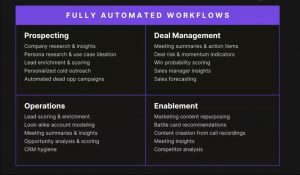
But abundance creates confusion. The point is not “What can AI do?”. The point is “What should you do first?”.
For a €5–15M ARR company with enterprise motions, the priorities are clear. There are five areas where AI delivers real, fast, high-leverage gains.
And let me be clear: AI does not replace the human. It removes the robot work so humans can focus on judgment work. Not automation. Augmentation. A “Cyborg GTM” team where the machine handles inputs and the human handles trust.
Let’s get into what actually moves the needle today.
From Manual Hunting to Sniper Targeting (Surgical ICP)
A healthy GTM engine knows exactly where it wins. It doesn’t “go broad”. It hunts with precision.
A few years ago, building an ICP-aligned list was slow, manual, and error-prone. Offshore teams scraping LinkedIn, graduates guessing emails, random signals.
Now it’s a different world: one operator with the right workflow can do the work of ten. Faster, cheaper, and with much higher accuracy. Signals, enrichment, timing — all available instantly.
But here’s the part most people miss: the hard work isn’t generating the list. It’s knowing exactly who belongs on it.
Accuracy is the new efficiency. If your ICP is not christal clear, AI amplifies the chaos. If it’s sharp, this becomes your fastest quick win. You move from “carpet bombing” to “sniper targeting”.
This is the first real quick win for a post-PMF scaleup.
A warning: Don’t get dragged into the “GTM engineering” hype where agencies try to rebuild your entire system overnight. At €5–15M ARR, you need leverage and momentum, not disruption. Start with precision. Unblock value fast. Evolve later.
From Templates to Hyper-Relevance (First Meetings)
If you’re still using templates and generic scripts, you’re leaving pipeline on the table. Buyers have built immunity.
The old world: “Hi {Name}, I saw on LinkedIn that…”. Some light research. A standardized script.
The AI world: Context-rich relevance. The AI can digest a prospect’s annual financial report, podcast interview, hiring pattern, and recent news. It turns that into a hook that actually earns a reply. Then the human adjusts tone and judgment.
You no longer have to choose between Quantity and Quality. It’s not “less work”. It’s better work. And it compounds.
One clarification: I remain skeptical of fully automated outbound cannons unless you sell a commodity. In enterprise motions, AI gives humans leverage; it doesn’t replace them.
AI for GTM as a sparring partner (The Coaching Lever)
This is where the leap becomes obvious.
Before AI, you relied on AE reports. You trusted their interpretation. You reviewed random call recordings. You hoped qualification happened as prescribed. Then came transcription. Useful, but shallow.
Now? AI analyzes every meeting. It contrasts it with your playbook, surfaces red flags, highlights missed questions and suggests next actions.
For the AE, it’s coaching. For the Manager, it’s clarity. For the CRO, it’s truth.
And truth is what GTM has been missing for years. We’ve left the persuasion era. We’re in the qualification era.
AI becomes your Sparring Partner. It forces rigor. It removes wishful thinking. It exposes reality. And reality is what drives forecast accuracy.
The Pipeline Notary (Forecast Integrity)
Let’s be honest: forecast calls used to be a negotiation between reality and optimism. Reps had “happy ears”. Managers had little visibility.
AI changes this dynamic completely. If the evidence isn’t in the data, the deal is not qualified. End of the story.
AI checks transcripts against your qualification framework (MEDDPIC or similar):
- Did the rep identify the Economic Buyer? No?
- Did they clarify the Decision Process? No?
- Did they confirm compelling event, competition, metrics? No?
If it’s not there, it’s flagged. Immediately. This is not surveillance. It’s discipline. Forecasting stops being storytelling. It becomes revenue.
Data Integrity and Leadership Visibility
This is the simplest and most misunderstood shift. Everyone talks about “saving reps time”. That’s irrelevant.
The real shift is CRM truth. AI captures what actually happened, not what the AE remembers, or chooses to report. Next steps, risks, objections, stakeholders, alignment: all surfaced and structured.
The CRM becomes reality and a strategic asset, not a fiction. Leadership finally operates with visibility:
- Are meetings following the intended choreography?
- Are opportunities meeting stage criteria?
- Where are reps skipping critical questions?
- Where is risk emerging?
- Where is coaching needed immediately?
This is leverage. This is operating with your eyes open.
The Vision: The GTM AI Operating System
If you implement a few of the points above, you’re already ahead of most of the market. But the real game is bigger.
The future of GTM isn’t a collection of AI tools. It’s a GTM AI Operating System.
You don’t need to rebuild everything. You don’t need a “GTM engineer” tomorrow. You don’t need a 6-month transformation.
You need clarity.
Start with one workflow where AI creates immediate value. Experiment. Codify. Scale what works.
The real frontier is not the toolset. It’s the operating model behind it. The best companies are already redesigning their GTM engines as unified systems. An AI-enabled operating layer that connects marketing, sales, CS and product into one motion.
Not more tools. Better systems. Faster signal-to-action loops. Less friction. More truth.
This is the real GTM AI Operating System.
Final Thought
There are no “AI experts” yet. We’re all learning in real time. The companies winning aren’t the ones waiting for clarity. They’re the ones already experimenting.
AI won’t replace your team. But a team that learns to use AI will outperform the one that doesn’t.
The threat isn’t AI. The threat is standing still.
If you enjoyed this post, you might also like:
 [The GTM Playbook Behind Woffu’s 9-Year SaaS Journey and Exit]
 Subscribe to SaaSification for no-fluff GTM insights, frameworks, and real stories for AI-driven SaaS leaders.