 Luigi Mallardo
I was recently working with the CEO of a vertical SaaS startup in the financial space. They were getting close to a significant enterprise opportunity. One of the largest firms in their addressable market. Two days of intensive workshops with the prospect’s team. Detailed feedback. Genuine engagement.
And a growing list of product requirements that the platform didn’t yet cover.
Table of Contents
The prospect had invested real time and resources in the evaluation. Their people had spent two days stress-testing the software, mapping gaps and identifying priorities. The CEO told me the prospect had made a comment that stayed with me.
“You should be grateful. We’ve helped you improve your product.”
My reaction was different from what they might have expected.
That perspective wasn’t evidence of a good partnership. It was a warning that the balance of the relationship was shifting, and that the startup risked accepting commitments it might later regret.
The shark in the room
In nature, a dolphin doesn’t defeat a shark by matching its strength. It survives by being more agile, by knowing where the shark is vulnerable, and by refusing to fight on the shark’s terms.
Large enterprise buyers are experienced negotiators. They know how to use time, complexity and the promise of future revenue to extract concessions from vendors who need the deal more than they should admit.
This doesn’t make them adversaries. It makes them rational.
The problem is when a startup accepts the buyer’s frame without realizing it. When every workshop produces another requirement. When the roadmap starts to reflect one customer’s priorities rather than the startup’s own judgment. When the economics of the deal quietly deteriorate while the relationship feels like it’s progressing.
At that point, the startup isn’t building a customer. It’s building a dependency.
Four Decisions That Protect ARR Quality
In those working sessions with the CEO, we worked through four decisions that would determine whether this deal became an asset or a liability.
Separate Feedback from the Roadmap
Not every requirement a prospect raises belongs in your development queue. Some of what the prospect was asking for was already on the roadmap. Some reflected their specific operational context more than a broader market need.
There was also a practical question: if the prospect had ten requirements, which ones were genuinely critical?
Asking the customer to prioritize wasn’t simply a way to reduce development effort. It forced both sides to distinguish essential requirements from desirable features.
And it reminded the buyer that the startup had other customers, other opportunities and its own product strategy.
Communicating this clearly isn’t arrogance. It’s discipline. A collaborative relationship doesn’t mean the customer writes your priorities. It means you listen carefully and then decide what to build, and explain why.
The moment you stop making that distinction, you’ve handed over something more valuable than a feature. You’ve handed over control of your product roadmap.
Verify Commitment Before Increasing Investment
Two productive days of workshops don’t equal a qualified opportunity. The prospect was engaged. The feedback was detailed. But engagement and commitment are different things.
Before going further, the right question wasn’t: what else do they need?
The immediate challenge wasn’t to demand a signature. The team had a one-hour meeting scheduled to review the prospect’s feedback and explain which requirements could be addressed.
I challenged them to use that meeting to establish priorities, surface any remaining deal-breakers, and make one thing clear: further development would require a different level of commercial commitment.
Not necessarily in that meeting. But as the next step.
Knowing when to introduce a commercial commitment matters almost as much as knowing that you need one.
Sell the Transformation, Not Just the Software
This was the most important shift in the conversation.
In a complex enterprise deal like this one, selling software or AI as a standalone product misses much of what the customer is actually committing to. The prospect isn’t buying access to a platform or an agent. They’re embarking on an operational transformation, with implementation, onboarding, integrations, change management, adoption and a significant investment of their own internal resources.
When you frame the deal as a license or agent purchase, the conversation gravitates toward features, tokens and pricing. When you frame it as a transformation project, the conversation shifts to outcomes, timelines, responsibilities and mutual commitment.
This reframing does something else. It qualifies the customer.
A prospect willing to engage with a transformation conversation has already demonstrated a different level of seriousness than one who just wants to compare feature lists. And the ones who aren’t ready for that conversation have told you something important before you’ve invested further.
Align Economic Commitment with Execution Risk
One option we discussed was a multi-year agreement with progressive milestones and exit clauses tied to clearly defined, verifiable technical performance.
The exit clause is not a concession. It’s a statement of confidence. You’re telling the prospect: we are certain enough about what we’re delivering that we’re willing to let you leave if we don’t deliver it. That makes the commitment more credible, not less.
And it asks the same of them. If a prospect hesitates at a structured long-term commitment with fair exit terms, you need to understand why before committing further resources.
The quality of ARR
Not every bad deal ends in churn. Some stay in the portfolio for years — consuming support resources, distorting the product roadmap, demanding discounts at renewal and producing margins that don’t justify the attention they require.
A churned customer is visible. A customer who stays but shouldn’t costs you in ways that don’t show up cleanly in any dashboard.
This is why ARR quality matters as much as ARR quantity.
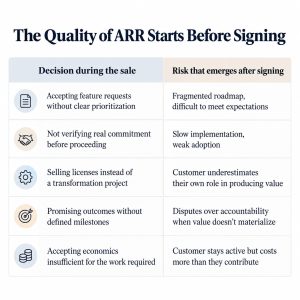
Many of these risks take shape before the contract is signed. And once the relationship is underway, they become much harder to correct.
Before the contract
The CEO I worked with had a decision to make. Continue following the rules of the game the prospect had established, or take back control of the conversation before it was too late.
The point is the question the CEO had to face: at what moment does pursuing this opportunity start to compromise the business you’re building?
Enterprise customers are worth winning. The right ones, on the right terms, create value on both sides for years.
But protecting that future value starts much earlier than most people think.
It starts with having the discipline to sell the right deal, not just the available deal.
The best churn protection isn’t a retention program.
It’s the judgment to know what you’re signing up for before you sign.
This is the third article in a series on ARR protection in complex B2B tech. The first — Blindsided Churn — covers how to recognize warning signs in apparently healthy accounts. The second — The 7-Year Itch — explores how to recover a long-term relationship that has entered crisis.
 Subscribe to my newsletter for practical GTM insights, frameworks, and real stories for complex B2B tech leaders.
Featured image: Karam Alani